

This is the first article in a series of four articles discussing how to properly fill out the four California construction releases described in California Civil Code 8132 – 8138.
Let me start by noting that in addition to practicing construction law for more than 35 years, I chaired the committee of California construction attorneys who revised those sections of the California Civil Code dealing with this release form and many other construction forms as part of Senate Bill 189 in 2010. I also wrote the first version of this release form and made it free to the public well before the new law took effect in 2012. With this background, let me note a few things about the Conditional Waiver and Release on Progress Payment form to help you avoid mistakes that might prevent you from achieving the intended effect or the form or releasing claim rights to a greater extent than you intend.
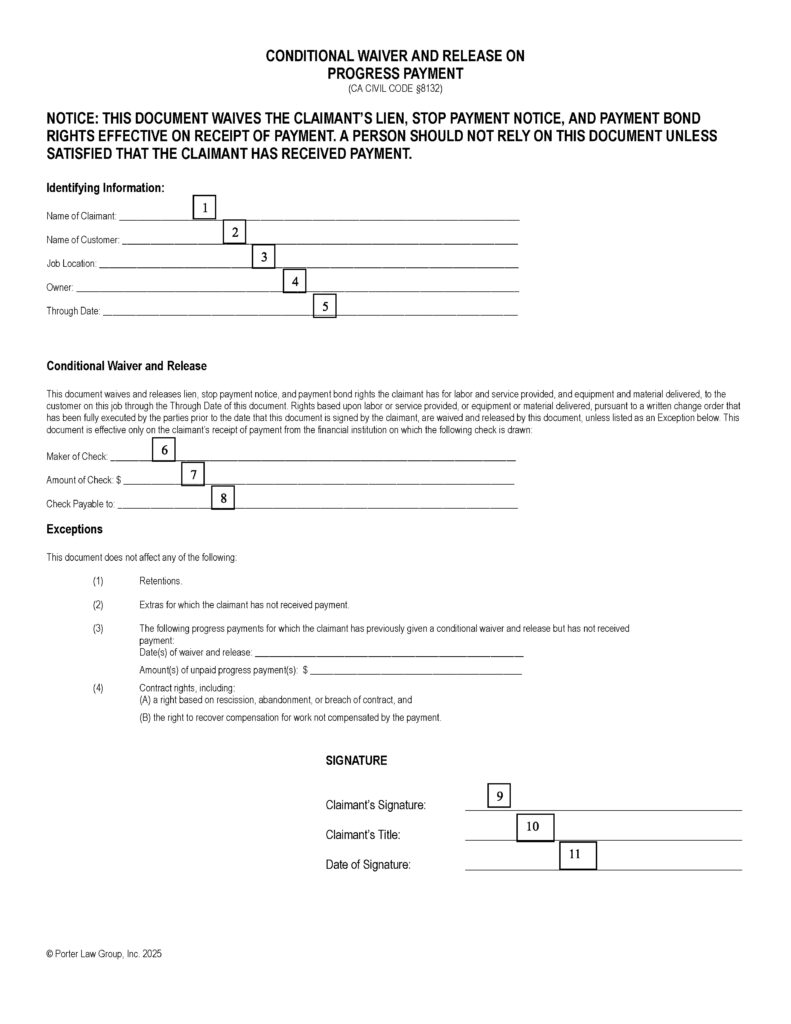
At the end of this article is a copy of the form itself which includes numbers coinciding with the instructions I will give below. A live electronically fillable version of the form is available on our firm’s website (www.porterlaw.com) under the “Forms” section. It is free and you can fill it out on your screen before printing it out and signing it.
As the title of the form states, this form is used in exchange for payment of a “progress payment” on a California Construction project. Progress payments are those payments made on a regular basis as a construction project progresses, often on a monthly basis or as certain milestones of progress on a construction project have been achieved by contractors and subcontractors. Use of the form is not mandatory, but it is often a part of the payment process contractually required by the terms of contracts and subcontracts used in construction.
Also, as the title to this form states, this form is “conditional,” meaning that this form will have no impact whatsoever unless the “condition” has been met. The condition is that the payment made in exchange for providing this release form clears the financial institution on which it is drawn and does not “bounce” and is not rescinded. If the check does not clear the financial institution or if the payment made is rescinded, this release form has no effect.
The important and intended impact of this particular release form is that to the extent that payment is received and clears the bank, the party filling out, signing and supplying the form gives up its rights to such powerful construction claim remedies as the mechanics lien, stop payment notice and payment bond claim (let’s call these “Claim Remedies”) on that project for the dollar value of all labor, services, good and materials provided to the “through date” specified on the form.
This particular release form is described in California Civil Code section 8132, which you should be able to access at this link: https://leginfo.legislature.ca.gov/faces/codes_displaySection.xhtml?lawCode=CIV§ionNum=8132.
Please finally note that the language of the form is not to be amended, revised or supplemented. California Civil Code section 8132 is clear that the waiver and release shall be “null, void, and unenforceable unless it is in substantially” the form required by the statute and as you will find attached to these instructions.
Instructions to fill out the form:
Please see the attached form. Each blank space is numbered to coincide with the description provided below:
- Name of claimant: This will be the name of the party filling out the form, which is generally the party to receive payment in exchange for the form. If you are a corporation or an LLC or another legal entity, use the name as is carried on the official records of the California Secretary of State and/or the California Contractors State License Board. If you are an individual, use your correct legal name. If you have a registered dba (“doing business as”), when filling out your name you would typically put your legal name, followed by a comma, and then your dba name. For example: Michael A. Jones, dba Jones Plumbing.
- Name of Customer: This will be the name of the customer of the person filling out the form. If you are filling out the form as a subcontractor, it will be the contractor or perhaps another subcontractor who hired you and will be paying you in exchange for the form. If you are a supplier, it will be the name of the party who purchased goods or materials from you. Again, use the proper legal name of the customer.
- Job Location: This is the location where you have been working or where the goods and materials you provided have been delivered for use on the project. A street address is generally fine. If no street address is yet available, for example, as is the case with some new projects, you may need to get a bit creative and descriptive. For example, “Walmart Store on Northeast corner of First and Main Street, Smithville, CA.” You should be able to rely on whatever is stated in your contract documents as to the job location. Be as accurate as you can, given the information you have been provided.
- Owner: This refers to the owner of the property where the work is being performed. This information may be difficult to obtain, as property owners often do not wish to be identified, are often LLC’s or other legal entities, and may not be clearly identified in the contract documents. In this regard, note that California Civil Code 8208 requires that the direct contractor (the contractor who has a contract with the property owner) shall provide the name and address of the owner as well as any construction lender to anyone who is seeking to provide a preliminary notice (see Civil Code 8200-8216 for info regarding the preliminary notice). If your contract or subcontract documents do not clearly identify the owner, seek the information from the direct or prime contractor. If resistance is encountered, you might do well to remind the direct contractor of their obligation under Civil Code 8208. Accurate information can also often be obtained from a title company or the County Recorder, although the law does not provide that those filing out the form are required to access such resources.
Note that if you are given an inaccurate name for the Owner and it later becomes an issue, you may be entitled to relief under the case of Force Framing v. Chinatrust Bank (2010) 187 Cal. App. 4th 1368 and the concepts discussed therein, which provided relief when a claimant was given inaccurate information.
- Through Date: This is one of the most important provisions on the form. If you, as the party filling out the form, receive the payment described on the form, and if the payment clears the bank (subject to the “Exceptions” described below), then you give up the right to record a mechanics lien or serve a stop payment notice or bond claim for any work performed or materials supplied on or before the date you write in this space. This is true even if you have not previously given an unconditional release form listing this date. Therefore, generally excluding any “retention” payments which might come after the project is over (usually 5% or 10% held for security), you will want to be sure that the payment you will be provided in exchange for this release form covers everything you provided to the project up to the date you put in this space. This is a very important date.
Conditional Waiver and Release: It is important to understand that this release is for a limited purpose. This release is “conditional” because it is not effective unless the condition of the payment described clearing the financial institution on which it was drawn has been met. The release has no effect if the check bounces or a check or wire transfer is rescinded. Also, this release only releases claims to mechanics liens, stop payment notices and bond claims, and even then, only to the extent of work performed and materials supplied to the “Through Date.” This release does not release contract claims, including claims for rescission and abandonment. So, even if you make a mistake in the use of this form, you will still have a legal right to seek payment by bringing a claim for “breach of contract” and possibly other claims, including rescission and abandonment, against the party who has failed to pay for the goods provided and the services performed. Note that this release form releases claims for work performed and materials supplied, pursuant to a written change order that was fully executed by the parties before the date that the release is signed by the claimant, unless it is listed as an “Exception,” below. Read the language of this section carefully.
- Maker of Check: This is almost always the contractor or subcontractor who hired you or who purchased goods or materials from you, although it could be another party if you independently agreed that payment could be coming from another source, including the Owner.
- Amount of Check: This is also another very important provision on the form. It is important to understand that except for the “Exceptions” noted below, the dollar amount you put here will result in you releasing your important rights to a mechanics lien, stop payment notice, or payment bond claim for all the work performed or materials supplied to the date you listed above in the “Through Date” section. It is therefore important to make sure that the Amount of the Check and the Through Date match. For purposes of the amount here, you may disregard retention and amounts listed in previously sent Conditional Waiver and Release on Progress Payment requests for which you have not yet received payment, as is noted below where “Exceptions” are discussed.
- Check Payable to: This will be the name of the business that is filling out and signing this form.
Exceptions: Please note that this release form does not affect any of the following:
- Retentions: Do not include any retention sums in the “Amount of Check” section. Retentions are paid at a later time and are the subject of a later release.
- Extras for which the claimant has not received payment: This exception gives you, as the claimant, leeway to later claim payment for work performed before the “Through Date” when that work was beyond the original scope or not originally anticipated by the parties involved but which the party filling out and signing the form was required to perform by the superior contractor or subcontractor, often through a work directive. It sometimes involves proposed change orders which have neither been approved nor denied, but where the work has been performed at the insistence of the superior party, sometimes in response to a contractor “directive” as may be allowed by the contract or subcontract. It is very important to document these “Extras” and note them on subsequent release forms where the opportunity is provided.
- The following progress payments for which the claimant has previously given a conditional waiver and release but has not received payment: This allows you, as the claimant, to note that on one or more prior occasions you sent a Conditional Waiver and Release on Progress Payment on a certain date and in a certain amount, but for which payment has not been received. For example, it might be the case that on January 20, 2025, a Conditional Waiver and Release on Progress Payment in the sum of $30,246.00 was sent, but no check in this sum has yet been received. This is where you would note the date and amount of that prior sent release (use the date the prior release was signed. Do not use the “through date” of the prior release). As to this prior Conditional Waiver and Release on Progress Payment for which payment has not been received, you would not include that past due amount in the “Amount of Check” section above. You would though note the date that prior document was signed (not the “through date”), and the amount listed on that prior document. If there is more than one prior Conditional Waiver and Release on Progress Payment sent for which payment has not been received, list each such date and amount.
In the first blank space in (3) the party filling out the form would write in the date of the prior release or releases for which payment has not been received.
In the second blank space in (3) the party signing the form would write in the amount(s) listed on the prior release or releases corresponding to the dates above.
- Contract Rights: It is very important to understand that this form of release only releases the right to make claims for mechanics liens, stop payment notices and payment bond claims. As described above in the section describing the “Conditional Waiver and Release,” this document does not waive or release a claimant’s right to bring a claim based on breach of contract, rescission, abandonment or for work performed or material supplied for which payment has not been received.
- Claimant’s Signature: Whomever is filling out the form will sign their name here.
- Claimant’s Title: This would be the title of the person signing, typically, Manager, CEO, CFO, Owner, Authorized Agent, Accounts Receivable Manager or some other title for the party who is receiving the payment, listed in the first blank line of this form.
- Date of Signature: Put in the date signing. Do not put in a date corresponding to the “Through Date” or any other date. The info provided here is only to describe the date the person signed this release document.
Service of the Conditional Waiver and Release on Progress Payment: The statute describing use of the form does not specify a manner of service, for instance, via certified mail, regular mail or email. In this regard, it is probably best to bend to the business practices of the party requesting the form. Hopefully, sending it by electronic service, including as an email attachment, will suffice. If the party requesting the form wishes to use some other manner of service, then use that manner of service.
Other issues: There is nothing in the law that requires that this release form be notarized. This is a difficult issue as using the services of a notary for every such release is an additional expense and inconvenience. You might persuade the party insisting on requiring a notary to drop the requirement by arguing that it is an alteration of the form that results in making the form “null, void and unenforceable” under California Civil Code 8132 (noted earlier in this article). Most owners, contractors and subcontractors would rather avoid such a consequence as they wish to have an enforceable waiver.
Additional language added to the release form, incorporating other documents or attempting to include additional waivers, including the very broad waiver found in Civil Code 1542 may cause the release to become “null, void and unenforceable” under Civil Code 8132. This may be a matter to be decided by the court.
There are four similar release forms described in California Civil Code 8132 – 8138. Each release is for a different purpose. Please review my instructions for each release form which can be found under either the “Articles” or “Forms” section on our website. In these locations you will find a free fillable version of the release form described in these instructions as well as the other three forms. Go to: www.porterlaw.com.
Article written by William L. Porter, Esq. in 2025. Mr. Porter is a principal in Porter Law Group, Inc. in Sacramento, California. He can be reached by phone at (916) 381-7868. Visit the firm’s website at www.porterlaw.com.
